Pentagon: Iran War Goals 'Will Take Time,' Not Endless Conflict
The Pentagon has given its first detailed public briefing on the ongoing US military operation against Iran, with Defence Secretary Pete Hegseth and Joint Chiefs Chairman Gen. Dan Caine outlining the strategy and aims while warning that the conflict will not end quickly.
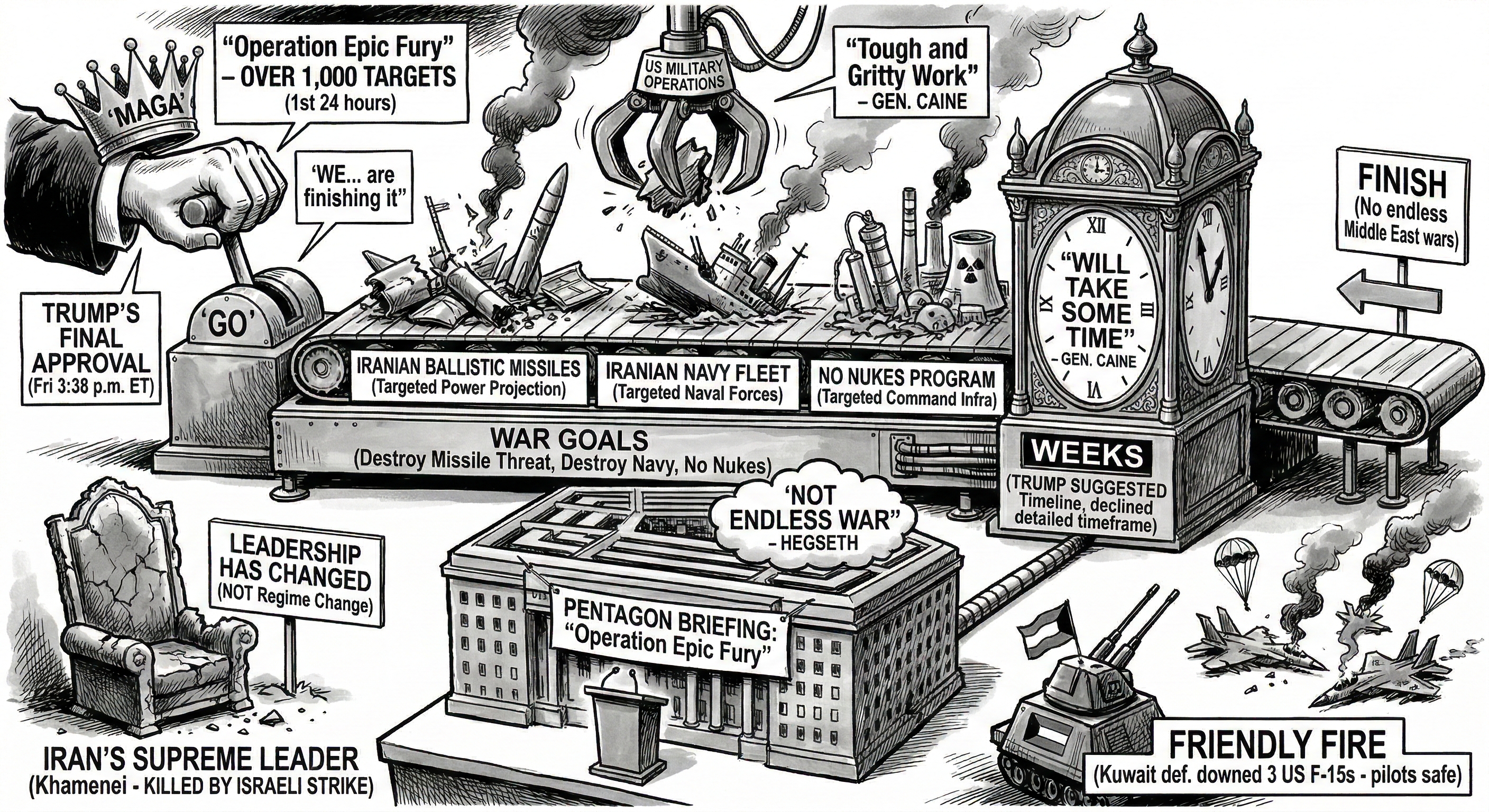
"We didn't start this war but under President Trump we're finishing it," Hegseth told reporters on March 2, framing the action as a response to years of Iranian attacks on US interests. The briefing confirmed the operation is called "Epic Fury" and began after President Trump gave final approval on Friday at 3:38 p.m. ET, authorising more than 100 aircraft and Tomahawk missiles to strike over 1,000 targets in the first 24 hours.
Gen. Caine emphasised that reaching the military objectives "will take some time to achieve, and in some cases will be tough and gritty work." He confirmed four US soldiers have been killed when an Iranian missile struck their fortified operations centre, and an investigation is ongoing into the friendly fire incident where Kuwaiti defences downed three US F-15s, whose crews ejected safely.
Hegseth stressed the operation is not "regime change," though he acknowledged the Iranian leadership "has changed" following the Israeli strike that killed Supreme Leader Ali Khamenei. The core goals, he said, are to "destroy the missile threats, destroy the navy, no nukes"—specifically targeting Iran's ability to project power beyond its borders by eliminating ballistic missiles, naval forces, and command infrastructure.
The briefing revealed that US Cyber Command and Space Force conducted pre-emptive operations to "blind Iran's ability to see, communicate and respond." While Trump suggested the war could last four weeks, Hegseth declined to provide a timeline, saying only that it will not become an "endless war" like previous Middle East interventions. Additional forces are arriving in the region as operations continue.